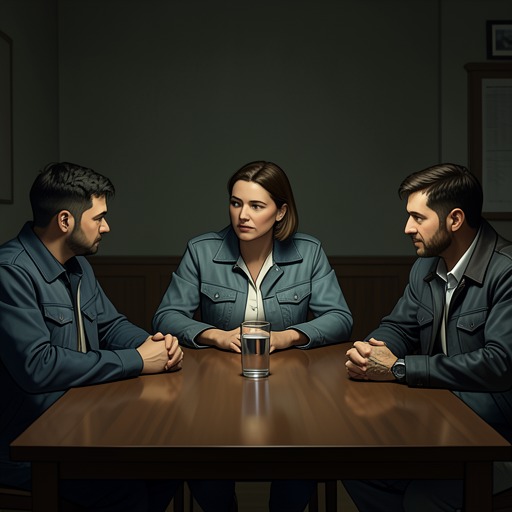
Timbre is harassed on a night bus
Hayden's TimbreTimbre is harassed on a night bus after leaving an apartment complex where she has allowed Hayden Devillier to believe she lives. The journey is not merely an uncomfortable commute: it becomes a near-assault that reveals how homelessness, secrecy, and late-night public transportation combine to place her in immediate danger. The event exposes the material vulnerability behind Timbre’s guarded independence and becomes a turning point in her relationship with Hayden Devillier, who later learns what happened and insists that she use his phone number when she needs help.
Causes and Circumstances
Timbre chooses the apartment complex because a bus stop stands just outside its gate, allowing her to return to the shelter without letting Hayden Devillier discover that she does not live there. After Hayden Devillier drives away, she waits in the complex’s poorly lit shadows until his truck disappears, then walks along the center of the internal road toward the gate. The darkness makes her uneasy, but the location seems preferable to revealing her actual residence. Her decision is therefore shaped by concealment as much as by transportation: she is protecting a lie because she fears the consequences of being known as homeless.
The bus ride begins under conditions Timbre already recognizes as unsafe. She chooses a seat near the driver, hoping proximity will offer protection, but the middle-of-the-night bus provides little real security. At the next stop, several older teenage boys board and sit directly behind her. They speak in a mixture of broken English and Spanish, laugh while looking toward her, and create an atmosphere in which she cannot understand every word but understands that she is being targeted. Her uncertainty about their language compounds her helplessness rather than relieving it.
Harassment on the Bus
The boys’ conduct escalates from staring and laughing to direct sexual intimidation. One leans close to Timbre’s head and addresses her as “babe,” asking whether she is worried that they will do something she might like. Timbre refuses to answer because she recognizes that a response could give them another opening to provoke her. She keeps her eyes on the back of the driver’s balding head rather than looking toward the men, concentrating on remaining unnoticed while the driver appears not to intervene.
The most immediate threat comes when a tall boy sits beside her and crowds her against the wall, trapping her in the seat. Timbre’s fear becomes physical: her sweat glands go into overdrive, and she draws a breath when he runs a finger down her arm, hoping that the touching will go no further. He then leans closer and calls her “puta,” offering a “real sweet ride” while the other boys laugh. Their remarks make the bus a confined space in which the men control the social atmosphere, her movement, and the terms of the encounter. Timbre’s silence is not passivity but a survival strategy within a situation where confrontation could intensify the danger.
The immediate interruption arrives when the bus stops again and two police officers board. Timbre looks at the door with dread, fearing that more passengers will join the group, but instead the officers speak briefly with the driver and appear ready to remain aboard. The young men leave through the other doors halfway down the bus. Only then can Timbre lean toward the railing separating her from the driver and take a deep breath. The officers do not directly narrate or resolve the encounter; their presence changes the boys’ behavior and gives Timbre a narrow opportunity to escape.
Return to the Shelter and Revelation
The danger does not end when the boys leave. Timbre must change buses twice because she initially misunderstands which stop connects with the area near the shelter. By the time she reaches her destination, the night she had hoped to manage through stubborn self-reliance has become a disaster. She enters the shelter as quietly as possible, removes only her shoes, and collapses onto the bed; sleep overtakes her before she can do more. When she wakes around noon, the shelter has emptied, and she must move quickly to cover her work shift despite having slept fitfully after the near-disaster.
The next conversation with Hayden Devillier reframes the event as a consequence of her secrecy. When he asks what happened and how she reached the shelter, Timbre explains that she rode the bus because a stop was outside the apartment complex’s gate. Hayden Devillier’s sarcastic response immediately signals that he understands the choice as reckless. After she explains that the boys mixed Spanish and English and that two police officers boarded, forcing the boys to get off, Hayden Devillier reacts with anger rooted in fear. He tells her that the officers saved her and that the men could have taken her from the bus, threatened her with a gun or knife, or forced her off without the driver noticing.
Hayden Devillier’s response also makes the concealed housing arrangement impossible to treat as a harmless deception. Timbre had endangered herself in order to preserve the appearance of having an apartment, while Hayden Devillier had been left unaware of the actual route she was taking. The event thus reveals not only the bus harassment but the larger conditions that produced it: a shelter resident trying to pass through a safer-looking world without admitting that she has no stable home.
Consequences and Significance
The incident changes the practical terms of Timbre’s connection with Hayden Devillier. He gives her his phone number and makes her promise to use it when she needs him, help, a ride, or anything else. Timbre agrees and promises there will be no more dangerous situations like the previous night. This exchange converts concern into an explicit support arrangement, challenging the self-reliance that led her to travel alone after dark and conceal the shelter.
The emotional force of the aftermath comes from the contrast between Hayden Devillier’s shouting and his physical response once he recognizes that anger cannot solve the problem. He crosses around the truck, pulls Timbre from it, and holds her tightly. His protectiveness does not erase the danger she experienced, and it does not make her prior choices irrational; instead, it reveals how quickly her independence can become exposure when she lacks secure transportation and housing. The event’s decisive significance lies in that exposure. A short trip from a false address to a real shelter becomes a test of who can safely move through the city, who is believed, and whether accepting help can be a form of survival rather than failure.